Showing posts with label WWF News. Show all posts

More power needed behind renewable energy push

Abu Dhabi, UAE - WWF has told an audience of energy experts and senior government officials from more than 20 countries that the world’s leading governments and businesses must lead the planet towards the benefits of renewable energy and a sustainable future.

At the second World Future Energy Summit in Abu Dhabi last week delegates were told that if everybody in the world consumed resources like the average person in a G8 country then another three planet Earths would be needed to sustain them.

Attending the summit were Professor Lord Nicholas Stern, author of the Stern Review on the Economics of Climate Change, and Dr Rajendra Pachauri, Chairman of the Nobel Peace-prize winning Intergovernmental Panel on Climate Change. The closing speaker was former British Prime Minister Tony Blair.

“If we are to change the paradigm then governments with unsustainable ecological footprints must set verifiable targets for reducing their carbon, water and commodity footprints,” Eduardo Gonçalves, International Coordinator for WWF’s One Planet Living initiative, told the delegates.

“They must remove the regulatory barriers to those businesses investing in a sustainable future. They must promote civic awareness of the impending ecological credit crunch.

“Businesses must reform their practices and look at the products they bring to the market. They must lobby governments for a level playing field for sustainable corporate practice, and promote sustainable consumer behaviour.

“And consumers must look again at their own choices and tell governments and business leaders that they demand a new paradigm.”

He went on to outline the fact that globally we are now outspending our natural income – the renewable natural resources the planet produces and replenishes – by 30 per cent and that figure is growing so fast that in another 25 years we are going to need another planet to live on.

WWF’s One Planet Living programme represents a radical shift from wasteful and inefficient consumption and production to an understanding of the natural limits of our ecosystems and the services they provide.

Gonçalves also went on to praise the work of summit hosts United Arab Emirates in the field of sustainability.

At the summit Abu Dhabi alone announced the first firm commitments from an Opec member to produce 7 per cent of its energy from renewables. It has also plendged $15bn to developing its Masdar low carbon city initiative and the establishment of a solar power joint venture.

“The government has signed an agreement with WWF to work with us and our partners to research the country’s national ecological footprint – the flows of energy, consumption of resources, and production of waste,” said Gonçalves, “and to work with us in mapping out a sustainable future for the country and its citizens.

“It is an example that should be followed, particularly by governments in North America and the European Union. The G8 countries may account for only 13 per cent of the world's population but they represent one third of humanity's total ecological footprint.”

In his closing remarks former Prime Minister Blair urged world leaders not to allow the current financial crisis to get in the way of the fight against climate change. He called for a new global agreement setting tough interim targets up to 2020 to transform countries into low-carbon economies.

“It is right now, at the instant when our thoughts are centred on the economic challenge, that we must not set to one side the challenge of global warming, but instead resolve to meet it and put the world on the path to a sustainable future,” he said.

“It needs not just a 2050 target but an interim target to get there, for example a target for 2020 that shows seriousness of intent and gives business a clear, unequivocal signal to invest in a low-carbon future.”

>>Read Full Article

Greek PM inundated with e-cards for climate action

21 Nov 2008

Athens, Greece: More than 3,000 Greek citizens have responded to a WWF call over the past four days by sending their Prime Minister, Kostas Karamanlis, a WWF e-card asking him to take an active part in the global efforts to fight climate change.

imageThe WWF e-card sent to the Greek Prime Minister by over 3,000 Greek citizens.
© WWF Greece

In the card is a projection of what Thessaloniki, Greece’s second biggest city, could look like around the middle of this century if action is not taken to stem global warming.

The senders also ask the PM to show the necessary political will during the next UN Climate Conference, in Poznan, Poland from 1-12 December 2008, where world leaders will be called upon to decide a 60-80 per cent reduction in CO2 emissions.

“Greece is a country which can develop sustainably based on clean energy and low greenhouse emissions,” said Demetres Karavellas, Director of WWF Greece.

“Our country is capable of responding to the challenge of climate change, given the right vision and the political will and given that the policies and measures are in place.”

The e-card action follows a new WWF Greece report prepared by Ecofys confirming that Greece can reduce its greenhouse gas emissions within the range proposed by the Inter-governmental Panel on Climate Change for the year 2050.

The study, “Solutions for climate change: a low carbon vision for Greece in 2050” defines a a CO2 emission reduction of up to 67 per cent by 2050.

It says the energy and construction sectors can help achieve the lion’s share of the reductions and cut emissions by up to 93 per cent by 2050.

In addition, renewable energy sources could generate 58 per cent of all power in 2050 while increased energy efficiency would result in more than half the envisaged emission reductions.

EU Environment Commissioner Stavros Dimas prefaced the WWF Greece report stressing that: “This is one of the most important reports that have been completed to date, presenting actions that a country like Greece could take in order to contribute in the common effort to combat the world climate challenge.”

>>Read Full Article

17 Nov 2008

Kathmandu, Nepal: Massive international investment in large-scale infrastructure projects in southern Asia will increase human-elephant conflict and cause more deaths on both sides unless much greater care is taken.

A new report released today, funded by the World Bank as part of the World Bank-WWF Alliance for Forest Conservation & Sustainable Use, warns international investors that a clear strategy for keeping human-elephant conflict under control makes economic as well as environmental sense.

image

It is estimated that the amount of economic damage caused by human-elephant conflict amounts to millions of dollars in some countries
© WWF-Canon / A. Christy WILLIAMS

It is estimated that the economic damage caused by human-elephant conflict amounts to millions of dollars in some countries and in many cases it is those responsible for new land developments that have to foot the bill.

“Billions of dollars lined up for regional and national level infrastructural investments such as the Trans-Asian highway project and various hydro-power and irrigation projects are going to significantly increase human-elephant conflict across Asia,” said Christy Williams, Coordinator of WWF’s Asian elephant and rhino conservation program.

“Banks and investors need to show leadership when it comes to human-elephant conflict by adding mitigation options into their large infrastructure plans in places where elephants are found from the beginning.”

Human-animal conflict is exacerbated whenever land where the animals traditionally find food and living space is taken away as human population and aspiration increases. In this situation elephants frequently raid crop fields and break down houses to get at stored crops.

Chance encounters between elephants and people, as well as efforts of people to guard against elephants, result in injury and death of humans. Harmful methods employed by people in the process result in death and injury of elephants, thereby escalating the conflict.

The report – Review of Human-Elephant Conflict Mitigation Measures Practised in South Asia – was compiled by WWF-Nepal, the Centre for Conservation and Research Sri Lanka (CCR) and the Nature Conservation Foundation.

It analyses case by case the methods local people are using to keep elephants away from their houses and finds that, in order to reduce the many costs of human-elephant conflict, a strategy that explains the most effective ways to mitigate the conflict is urgently needed.

The report notes that a comprehensive strategy could help investors planning infrastructure projects in south Asia to include human-elephant conflict mitigation options from the beginning, which would lead to both economic and conservation gains.

"Most mitigation measures currently being used are just akin to bandaging the wounds and not treating the root cause,” said Prithiviraj Fernando, chairman of CCR-Sri Lanka. “Good land-use planning that takes both people and elephant needs into account is the only long-term solution.”

>>Read Full Article

EU’s ideas for energy looking tired

13 Nov 2008

Brussels, Belgium: A coherent plan to reduce energy consumption was conspicuous by its absence from the European Union’s latest attempt to deal with the energy and climate crisis.
The European Commission today released an “Energy security and solidarity action plan”, which addresses some of the gaps in the present EU climate and energy policy.

image

Energy efficiency is the most immediate and cost-effective solution to reduce greenhouse gas emissions, ensure resilience to an economic crisis and improve security of energy supply.
© WWF-Canon / Michel Gunther

But there were major contradictions among suggested policies, a lack of ambition and a mixture of actions with little relevance for the environmental and economic objectives outlined in the proposals.

Energy efficiency is the most immediate and cost-effective solution to reduce greenhouse gas emissions, ensure resilience to an economic crisis and improve security of energy supply in Europe. Despite this it remains absent from the European Union energy policy.

“Proposed measures fail in ambition as they do not include a mandatory energy saving target of 20 per cent by 2020 for the European Union,” said Mariangiola Fabbri, Energy Policy Officer at WWF-EPO.

“This is key to reduce consumers’ energy bill, boost innovation, facilitate the achievement of the EU’s greenhouse gas emissions reduction targets and support a strong EU performance at international climate negotiations.”

As Europe’s buildings account for 40 per cent of EU final energy use, the improvement of the Energy Performance of Buildings Directive should be a priority and an opportunity not to be missed to strengthen the EU’s climate and energy goals.

“EU countries should have been obliged to have stricter standards for both existing and new buildings by 2015,” said Fabbri. “We need to shift buildings from being energy wasters to climate savers.”

On a more positive note the EU intends to embark on the “Renewable energy supergrid”, an innovative electricity highway to connect solar power from southern Europe and north Africa, offshore wind power produced in the Atlantic and other renewable energy sources from the mainland. However, a continuous focus on fossil fuels might undermine this project.

“The renewable energy supergrid must become a priority as it has the potential to provide renewable electricity to all European citizens and make the European energy sector carbon-free in the decades to come,” said Dr Stephan Singer, WWF’s Global Energy Policy Director.

“It is disappointing, though, to see new investments for infrastructures that keep Europe dependent on oil, gas and other conventional fuels which counteract the benefit of renewable energy.”

WWF is urging the European Parliament and the Council of Ministers to strengthen the laws and come to an agreement before the EU elections in June 2009.

>>Read Full Article

Canadian territory fails to protect polar bears

10 Nov 2008 

Iqaluit, Canada: Canada's youngest territory is facing an international backlash following its decision to leave unchanged the number of polar bears it allows to be killed in part of the Baffin Bay region each year.

You can't pretend to be looking after polar bears by carrying on with the same level of harvest that has led to a 30 per cent decline in the population, it is just totally unacceptable.' Peter J. Ewins, director of species conservation, WWF-Canada
© WWF-Canada / Peter Ewins

Nunavut, which came into being in 1999, has bowed to pressure from the local Inuit hunters and agreed to maintain the annual allowable harvest quota of 105 polar bears. The Baffin Bay sub-population straddles Canada and adjacent areas of Greenland. The number of polar bears has dropped from an estimated 2,100 in 1997 to about 1,500 today due to high levels of hunting by Inuit in both countries.

The hunting quota was set at 105 in 2004, based on the relatively large population numbers from the late 1990s. The harvesting in Nunavut was also based on an assumption that the number of bears killed in neighbouring Greenland was as low as 18 a year, but subsequent research has shown the actual figure to be about 10 times higher.

"You can't pretend to be looking after polar bears by carrying on with the same level of harvest that has led to a 30 per cent decline in the population, it is just totally unacceptable,” Peter J. Ewins, director of species conservation for WWF-Canada, told Canada's Globe and Mail newspaper.

WWF is calling for a joint management plan between Greenland, Nunavut and the federal Canadian government that would allow populations to recover and then be managed on a sustainable level.

For many environmentalists, polar bears have become a symbol of global warming because the ice habitat that they depend on is melting due to climate change.

Environmentalists have warned that the hunting decision may lead to international boycotts against Nunavut, and to concerns that the government, which relies heavily on advice from Inuit hunters, is ignoring the scientific research showing a precipitous plunge in the number of bears.

>>Read Full Article

G8 nations lagging in climate change race


03 Jul 2008

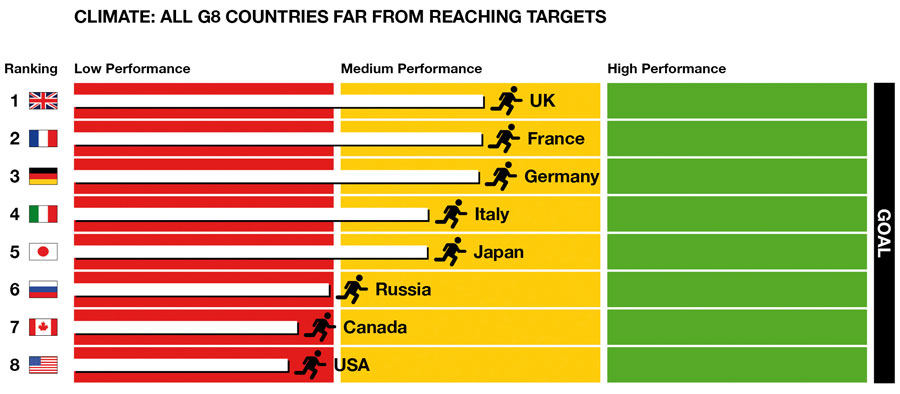
None of the leading industrialized nations are currently on target to reduce greenhouse gas emissions enough to avoid the threshold level for unacceptable risk of catastrophic climate change, according to new research into national policies and performance.

The G8 Climate Scorecards 2008, compiled by climate consultancy Ecofys on a joint commission from environmental organization WWF and international financial services provider Allianz, was released four days prior to the G8 summit in Japan.

Leading the race is the UK, which is projected to reach its Kyoto target and has introduced innovative policies such as the Climate Change Bill. France lies in second place just ahead of Germany, which performs best on renewable energy, but all three are at best half as far along the road as they should be, with the use of coal still a major problem.

Italy, Japan and Russia are firmly entrenched in mid-table, while bringing up the rear are Canada and the USA which, according to the report, “is no surprise given rising emissions and energy-intensive economies and their failure to realize the full potential of energy efficiency improvements”.

“Time is running out,” said Regine Günther, Director of the WWF Climate Change Programme in Germany. “We have 10 to 15 years left in which the global emissions have to peak and decline. The world is at a crossroads where decisive action now could translate into economic success.”

The scorecards rank the G8 countries according to nine quantitative indicators, including past emission trends since 1990 and progress against the country’s Kyoto target. It also scores performance on three specific policy areas - energy efficiency, renewable energy, and development of carbon markets.


The report analyzed the policies of emerging economies Brazil, China, India, Mexico and South Africa and, while noting that they cannot be measured by the same criteria, stressed that the question of how industrialized countries will assist these five countries remains key.

Dr. Joachim Faber, holding board member of Allianz SE, said: “The G8 countries have a responsibility to be high achievers in the race against climate change. They need to be role models trail-blazing the way to steer the world towards a low carbon, clean energy economy.”

Leaders at next week’s summit in Japan should commit to a binding long-term target for emission reductions of 80% by 2050, and as close as possible to 40% by 2020, the report states. “We expect the Japanese Presidency of the Hokkaido Summit to commit the G8 countries to significant and binding emission reduction targets,” said Günther.

“The G8 should pledge financial and technology support for low carbon development and for adaptation measures in developing countries that are measurable, reportable and verifiable.”

>>Read Full Article

Ministers commit to zero net deforestation by 2020

30 May 2008

Postcard update:
As at 30 May 2008 when the 9th Conference of Parties to the Convention on Biological Diversity (CBD COP9) ended, 67 countries plus the European Commission and others including the CBD Secretariat, Commission of Forestry in Central Africa (COMIFAC) and UNEP, had signed on to support WWF's call for zero net deforestation by 2020. There is still time for others to join in the call. Contact us for a postcard!

Bonn, 28 May 2008 – Environment ministers from 60 countries including Germany, host of the 9th Conference of Parties to the Convention on Biological Diversity (CBD COP9), today showed WWF and the world they are serious in the fight to stop forest loss, thereby safeguarding biodiversity, global climate and people's well-being. The ministers showed their commitment at a WWF event held during the conference in Bonn.

Led by the CBD Executive Secretary, Dr Ahmed Djoghlaf, the ministers and the EU Commissioner for the Environment made their commitment via signed postcards addressed to WWF International's Director-General, Mr James Leape.

"WWF is very pleased that governments are rising to the challenge of working towards zero net deforestation by 2020," said Mr Leape, who received the postcards from the ministers. "I strongly urged other governments to follow the lead of these countries to agree on this target."

Despite much efforts, deforestation continues at an alarming rate  13 million hectares per year, or 36 football fields a minute. Deforestation and degradation of the world's forests have dramatic consequences for biodiversity, global climate and millions of people. Forest contains 90 per cent of the world's terrestrial biodiversity and have a vital role to play in the fight against global warming, being the largest storehouse of carbon on Earth. Deforestation, particularly in the tropics, is the third largest source of greenhouse gas emissions, generating between 15-20 per cent of global carbon emissions.

Loss of forests also implies the loss of goods and major ecological services to humanity  food, medicine, watershed protection, livelihoods, and climate and disaster mitigation. About 1.6 billion people worldwide depend on forests for their livelihoods, with 60 million indigenous people depending on forests for their subsistence.

"We need to reverse the trend in forest loss and stop further erosion of the world's biodiversity, both for nature and people's sakes," said Dr Djoghlaf. “This initiative is welcome news for the biodiversity family gathered here in Bonn, to expedite the implementation of the three objectives of the Convention on Biological Diversity. It is indeed a timely initiative, and I applaud WWF for its unique contribution for protecting life on Earth.”

WWF has set the 2020 zero deforestation target to support and enhance the CBD's Forest Programme of Work. The target also complements global efforts under the UN Framework Convention on Climate Change, which at its conference of parties in Bali last December, which acknowledged the need to reduce carbon emissions from deforestation and forest degradation. Although ambitious, the target does provide sufficient time for action as reducing emissions from deforestation and forest degradation (REDD) initiatives will be operational when the second commitment period of the Kyoto Protocol comes into effect post 2012. Additionally, as a study by WWF-Brazil and partners launched yesterday revealed, protected areas is a useful and viable tool to achieve reduction in forest loss and mitigating climate change.

"WWF would like to see the CBD COP9 adopt this 2020 zero net deforestation target here in Bonn," Mr Leape said. "Governments have to act now or we will lose even more the forests that are life's basic building blocks, and that provide essential services to humanity."

WWF thanks all ministers who signed the postcards and pledges to support and work with them in the fight to stop forest loss.

For further information:
Gerald Steindlegger, WWF International,
tel: +43 676 83488216, gerald.steindlegger@wwf.at
Chng Soh-Koon, WWF International, tel: +41 79 4099788, skchng@wwfint.org


>>Read Full Article

Creative Commons License
World Today Blog by abul fahd is licensed under a Creative Commons Attribution-Share Alike 3.0 United States License.
Based on a work at www.panda.org.
Permissions beyond the scope of this license may be available at www.panda.org/using_site_content/index.cfm